Party Line
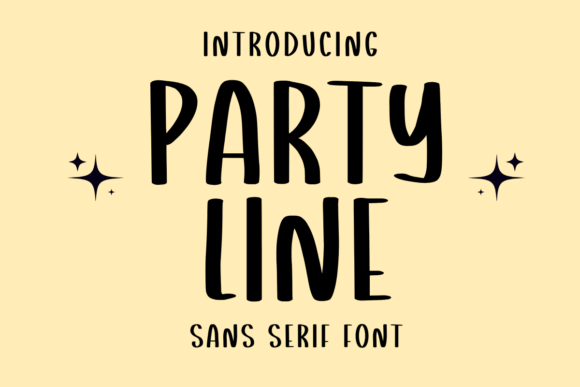
The first time I saw Party Line, it felt like a warm hug wrapped in neon. It’s not the kind of font that shouts, but one that whispers confidence with a playful edge. The letters are clean and modern, yet they carry a subtle personality that makes them feel alive. It’s the kind of typeface that could easily fit on a poster for a music festival or a sleek logo for a boutique coffee shop. Its structure is balanced, with a friendly slant that suggests approachability without sacrificing professionalism.
Party Line is a sans serif font, which means it lacks the small lines found in serif fonts. This makes it versatile for both digital and print projects. It’s particularly effective when you want to maintain clarity while adding a touch of character. The letterforms are well-proportioned, with consistent spacing that allows for easy readability even at smaller sizes. However, its charm lies in the details—like the slight weight variation in the serifs (even though it's sans serif) and the gentle curve in the lowercase 'o' that adds a softness to the otherwise geometric design.
When it comes to real-life applications, Party Line shines in branding and logo design. It’s ideal for logos that need to be both memorable and readable. A boutique brand might use it for their tagline, while a more established company could deploy it as part of a secondary brand identity. In packaging design, it can add a stylish touch without overwhelming the visual hierarchy. For product labels, especially those with a modern or minimalist aesthetic, Party Line offers a clean alternative to more traditional fonts.
On social media graphics, Party Line brings a fresh energy. It works well in Canva templates and Cricut projects, where its legibility and style make it a go-to choice for creatives looking to stand out. When paired with other fonts, such as a serif font for contrast or a script font for flair, it can create a dynamic font pairing that feels intentional rather than forced. In editorial design, it’s great for headlines or subheadings, offering a modern twist without sacrificing readability.
However, there are moments when Party Line should be used with care. Large headlines can sometimes feel too casual if not balanced with other elements. It’s best suited for short phrases, quotes, or decorative accents rather than long blocks of text. On websites, it performs well in headers and call-to-action buttons, but should be tested in black and white to ensure it holds up under different lighting conditions. Small-size readability is another consideration—while it’s generally clear, it’s worth checking how it looks in tight spaces or on mobile devices.
In terms of brand consistency, Party Line can help reinforce a brand’s personality. If your brand is youthful and vibrant, this font can align perfectly. But if your audience prefers a more formal tone, you might want to consider a different option. That said, Party Line has enough versatility to work across multiple brand identities, especially when used thoughtfully.
One thing that stands out about Party Line is its ability to adapt. Whether it’s on a flyer, a website header, or a printable design, it maintains its character while remaining functional. It’s a premium font that offers value for its price, making it an excellent choice for designers who need a reliable, stylish typeface for commercial use.
Testing Party Line alongside other styles is essential. When compared to a serif font, it offers a cleaner, more modern look. Against a script or handwritten font, it provides a strong contrast that can elevate the overall design. And when placed next to another sans serif font, it can either complement or compete, depending on the balance achieved. This makes it a great candidate for font pairing experiments, especially in web design and social media graphics.
For designers working on digital products, Party Line is a solid choice. It renders well on screens and maintains its integrity when scaled down. However, it’s important to confirm commercial licensing before using it in client work or business assets. Always check the font’s usage rights to avoid any legal issues, especially when creating printable designs or selling digital products.
In summary, Party Line is a versatile, modern sans serif font that brings a unique personality to any project. It’s perfect for branding, packaging, social media, and editorial design, but requires careful consideration when used in large formats or long texts. As a designer, I find it to be a valuable addition to my toolkit—one that balances style with functionality, and personality with professionalism.